
James Whitaker
CEO & Founder
James spent 2018–2023 at CMU's Robotics Institute — first as a PhD student on legged locomotion, then as a postdoc building dexterous manipulation primitives. Every platform ran into the same constraint: no joint actuator on the market shipped with a real FOC stack, a 19-bit absolute encoder, and a working ROS 2 hardware_interface out of the box. He wrote custom Park/Clarke + DQ-frame PI firmware on top of industrial servos for five years before concluding it was faster to design the right actuator once. In 2024 he founded Tendonkindle and built the first TK-120 prototype in Pittsburgh. He oversees hardware architecture, firmware roadmap, and all customer engineering discussions.
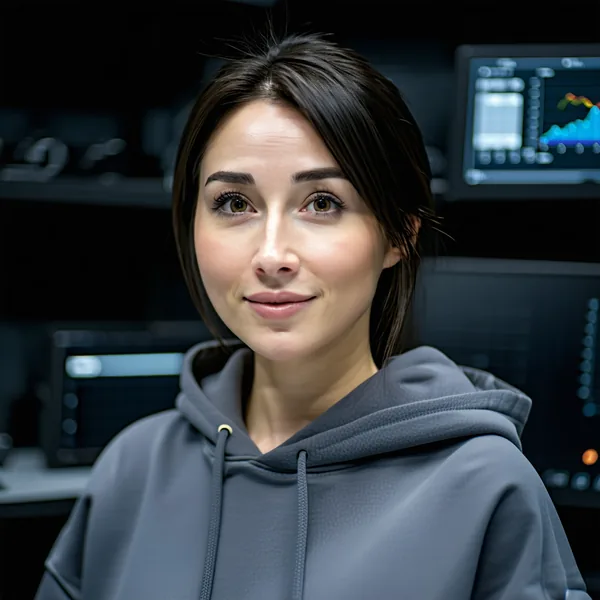
Mei-Lin Chen
Mechanical Engineering Lead
Mei-Lin leads mechanical design of the TK actuator housings, harmonic drive flex-spline integration, and thermal management architecture. Before joining, she spent four years at a Pittsburgh precision-automation supplier designing compound planetary gearbox assemblies for micro-surgical robotic end-effectors — work where sub-10 µm radial runout and cogging torque under 0.05 Nm were standard requirements. At Tendonkindle she owns the stack from housing tolerances to output-shaft seal selection. She wrote the IP54 and IP67 sealing specs for TK-120 and TK-480 respectively.

Arjun Nair
Firmware Engineer
Arjun wrote the FOC control loop that runs on STM32G4 at 400 Hz. Before Tendonkindle he spent three years on an EV motor-controller team implementing space-vector PWM at 40 kHz with dead-time compensation and three-shunt current measurement. At Tendonkindle he owns the full firmware stack: the DQ-frame PI current controllers, the outer velocity and position loops, the micro-ROS DDS transport layer, CANopen CiA 402 state machine, and the EEPROM parameter register map. He also authored the dyno characterization script that generates the torque-speed curve data shipped with every datasheet.

Ryan Kowalski
Controls Engineer
Ryan designs the joint impedance controller and the outer velocity and position loops that sit above the FOC current layer. He came from a CMU quadruped locomotion research group where he implemented whole-body controllers using MIT Cheetah-style torque control — direct torque commands to each joint via the DQ current reference, with EKF-based state estimation and Cartesian compliance in stance. At Tendonkindle he translated that work into the TK impedance API: runtime-tunable Kp and Kd over ROS 2 topic or EtherCAT SDO, with updates effective within one 2.5 ms control cycle.

Dara Okafor
Business Development
Dara manages engineering sample programs, OEM evaluation relationships, and the academic lab partner program. She came from a defense-adjacent robotics systems supplier where she handled program management for multi-year development contracts — the kind of work where a misaligned NRE clause costs a quarter. At Tendonkindle she is the first contact for any OEM evaluation team or university lab, and she owns the gap between "we need a sample" and "we have a signed purchase order." She knows what procurement engineers need to see before they can approve a new supplier.